

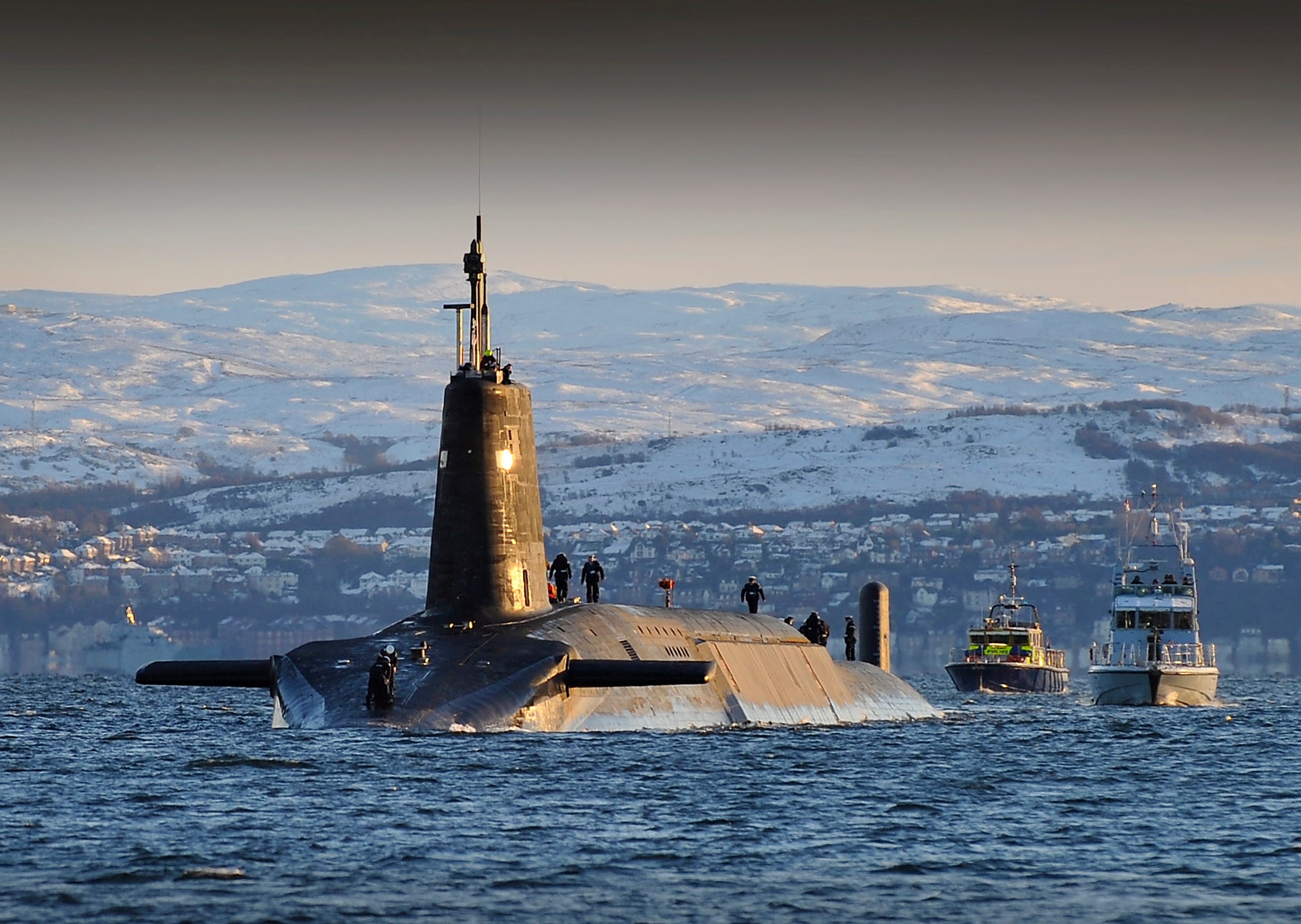
The Government’s highly anticipated Defence Investment Plan was revealed last month, with the plan’s backers hailing it as a transformation built on drones and artificial intelligence – but the numbers reveal an ironclad commitment to submarine-based nuclear deterrence, with spending dwarfing new investment in novel technology like drones.
Analysis of the figures shows Britain’s nuclear deterrent and its associated costs continue to vastly exceed all other military spending. The plan, which commits £298 billion to UK defence over four years to 2030, ring-fences £63.6 billion for the Defence Nuclear Enterprise – the Dreadnought submarine programme, a replacement nuclear warhead named Astraea, and the nuclear-powered AUKUS attack submarine programme. The DIP says this is over £20 billion more than was spent across the previous four-year period.
The significant investment comes amid warnings that the nuclear deterrent’s cost is crowding out innovation elsewhere.
Giving evidence to the Commons Defence Committee on 7 July, Lord Robertson – the lead author of the Strategic Defence Review that preceded the DIP, and a former NATO Secretary General – told MPs that the nuclear budget was constraining Britain’s wider military ambitions.
He said: “Our nuclear forces take up at least 20%, maybe even 25%, of the MOD budget. It is crucial to the security of this country, and indeed to wider Europe, that we have that independent nuclear deterrent – the only one that is committed to NATO.
“However, it is very expensive and that crowds out a lot of the other ambitions that the country might want to have at the moment.”
Lord Robertson added: “This needs to be seen in the broader context. If we are going to have an independent nuclear deterrent, we have to be able to pay the price of that and face the fact that it squeezes the conventional defence of the country and our wider contribution to NATO much more tightly.”
Within the nuclear spend, the plan allocates £47 billion to submarines, including infrastructure and maintenance, £13 billion to warhead development, £1.7 billion to a nuclear fuels programme and £290 million to nuclear workforce skills. The submarine figure covers four building programmes running in parallel for the first time – Dreadnought, concept work on its eventual successor, the tail of the Astute class, and up to 12 SSN-AUKUS boats – taking the Royal Navy’s nuclear-powered fleet from 11 boats to a potential 16.
The Government agreed in June to seek to establish a new Commons committee to scrutinise the enterprise’s spending, after the Public Accounts Committee found the MoD could not account for more than £6 billion of its assets.
Drones and autonomous systems which dominated coverage surrounding the plan will stretch to just £5 billion across the three services – less than a twelfth of the nuclear commitment and smaller than the budgets for munitions and the Tempest fighter programme.
General Sir Richard Barrons, the SDR’s other external reviewer and a former Deputy Chief of the Defence Staff, told the same July Commons Defence Committee he would have gone harder and faster on both.
He said: “I do wish that we had had money set aside for some of the bigger transformations. I would have moved faster on the digital targeting web, for example, because I do not think that it is really difficult. I would have put more money into the attritable drones, which have just appeared in the DIP for the Navy, the Air Force and the Army.”
General Barrons said the plan captured the right direction of travel but moved too slowly for the threat, adding: “It makes and accelerates some early moves, but they are small in number, and then a lot of it is too leisurely for the world we live in.”
Four years into Russia’s war in Ukraine, and amid a US-Israeli war with Iran centred on its nuclear ambitions, Britain’s nuclear deterrent remains a core pillar of its military doctrine, with four nuclear-powered ballistic missile submarines of the Vanguard class conducting ‘continuous at-sea deterrent’ to dissuade adversaries from strategic-level attacks.
The Defence Investment Plan itself said: “The [Strategic Defence Review] made clear that a modernised nuclear deterrent is essential for the defence of the UK. It underpins our security in a new nuclear age and worsening security environment, characterised by Russia’s aggression, China’s nuclear expansion, and North Korea’s destabilising weapons programme.
“As one of only three nuclear powers in NATO, the UK provides the ultimate guarantee of security for itself and its NATO allies.”
The plan does continue to leave space for innovation, with £100 million ring-fenced for the new Rapid AI Delivery Taskforce, known as TF RAID.
Chief of the Defence Staff, Air Chief Marshal Sir Richard Knighton, said: “I am determined that TF RAID is not just another piece of window dressing, set up to give us comfort that something is happening. The focus of Taskforce RAID is on delivering necessary operational capability, quickly.”
It comes as the Government scrambles to keep up with rapidly evolving improvements in AI and their applications in defence and industry. US export controls in June briefly cut off global access to Anthropic’s most advanced model, Fable – restrictions imposed on 12 June and withdrawn on 30 June – in an episode that caused disquiet in Whitehall over the reliability of American supplied AI applications.
The Government has said defence spending between 2030 and 2035 has been deliberately left unallocated, which the MoD says will allow it to respond as the threat evolves and technology advances.
With political and privacy concerns raised in recent months by opponents of US AI company Palantir’s contracts with customers including the MoD and Metropolitan Police, home-grown British alternatives are increasingly being sought.